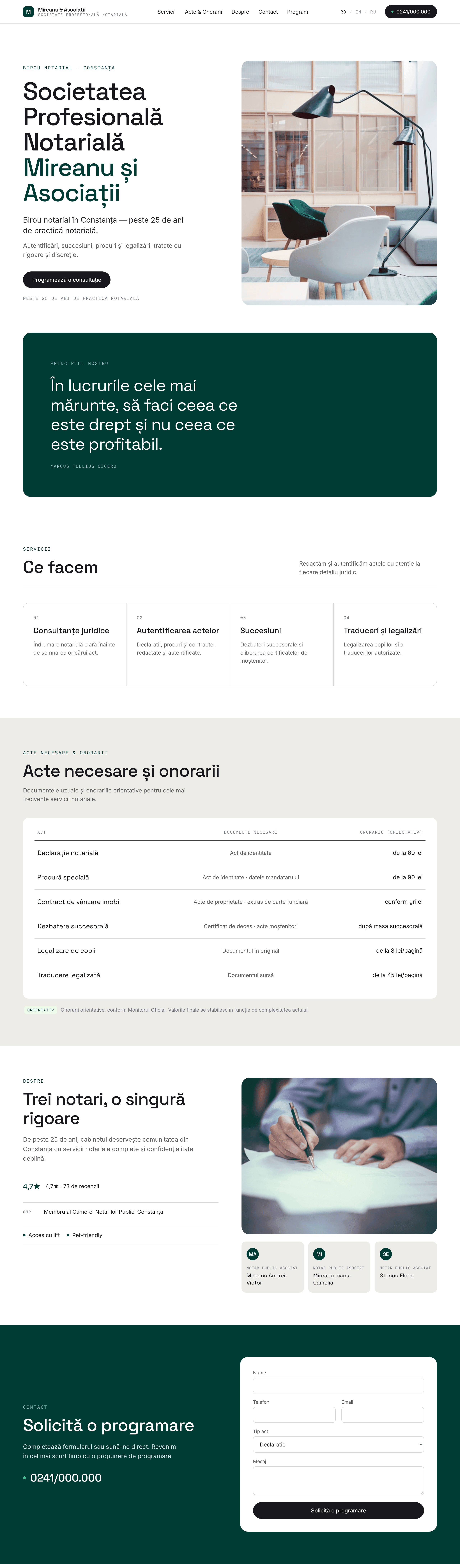

A self-initiated concept study. We produced this unsolicited to show how we'd approach the brief - it hasn't been commissioned or launched.
A notary office with more than 25 years of practice in Constanța, three notaries, a top-rated Google profile, and clients served in Romanian, English, and Russian - in a coastal city where every foreign property purchase passes through a notary. Online, the office barely existed: a hand-coded static site with fixed-width layouts that break on a phone, no contact form, Romanian only, untouched for years. And the site wasn't even linked from the office's Google listing - so to everyone who found the practice on Maps, one of the city's most established legal offices looked like it had no website at all.
The situation
This wasn't a business that needed rescuing. The reputation, the throughput, the multilingual clientele - all of it was already there. What was missing was any digital surface that matched it.
Invisible at the moment of comparison. Someone searching "notar Constanța" sees a strong rating - and no website. The three nearest competitors look identical in that list; nothing carries the office's standing across.
A site that undermines the office it represents. Reviewers praise an elegant, modern office; the website renders broken on the very phones people search from. The one asset off-brand with everything else the practice pays for.
English and Russian clients, a Romanian-only site. The office already serves foreign buyers verbally - the largest closing cost in their purchase - but nothing online speaks to them in writing.
A market-wide gap. We surveyed the field: of roughly fifty notary offices in the city, almost none has a real website - and not one has a modern responsive site, a multilingual version, or a way to request an appointment online.
The constraint that shaped everything
Notaries in Romania are barred from advertising: no comparative claims, no solicitation, no marketing hype. That rules out nearly everything a typical agency site reaches for - and it's exactly why most agencies get this profession wrong. But the deontological code explicitly permits a sober informational site: services, required documents, published fee schedules, contact, and an appointment request. Read carefully, the rules don't just allow a website - they define the brief.
Restraint wasn't a stylistic choice here. It was the legal specification - and the design opportunity.
The idea
Build the first notary site in the city that actually looks like the institution it represents - and treat the appointment-request form as the centerpiece, because it's one of the only client-acquisition channels the profession is legally allowed to have. Not catching up to competitors; there was nothing to catch up to. Defining what a notary's digital presence should look like, first.
The approach
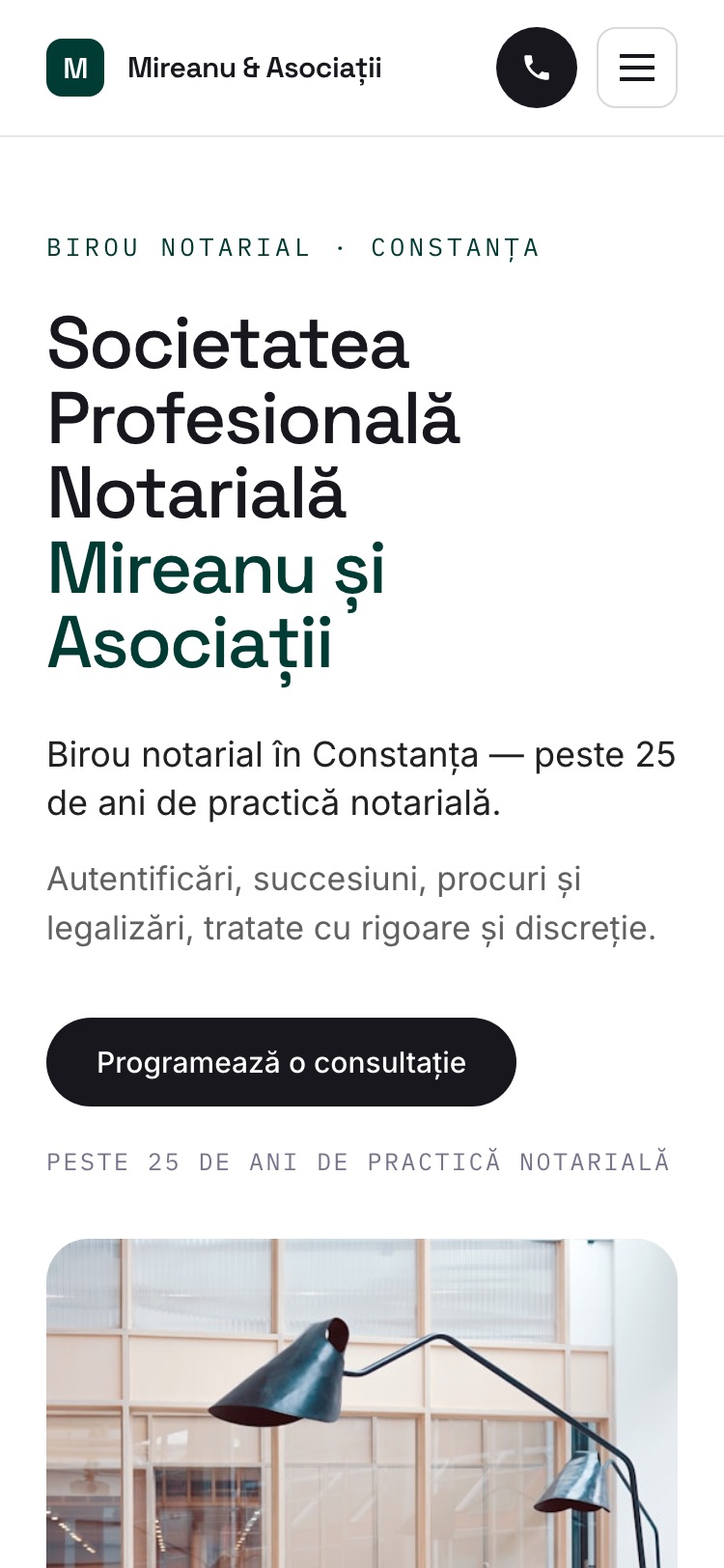
Mobile-first, because that's where the searches happen - and where the old site failed most visibly. Every section maps to something the deontology explicitly permits, and nothing more.
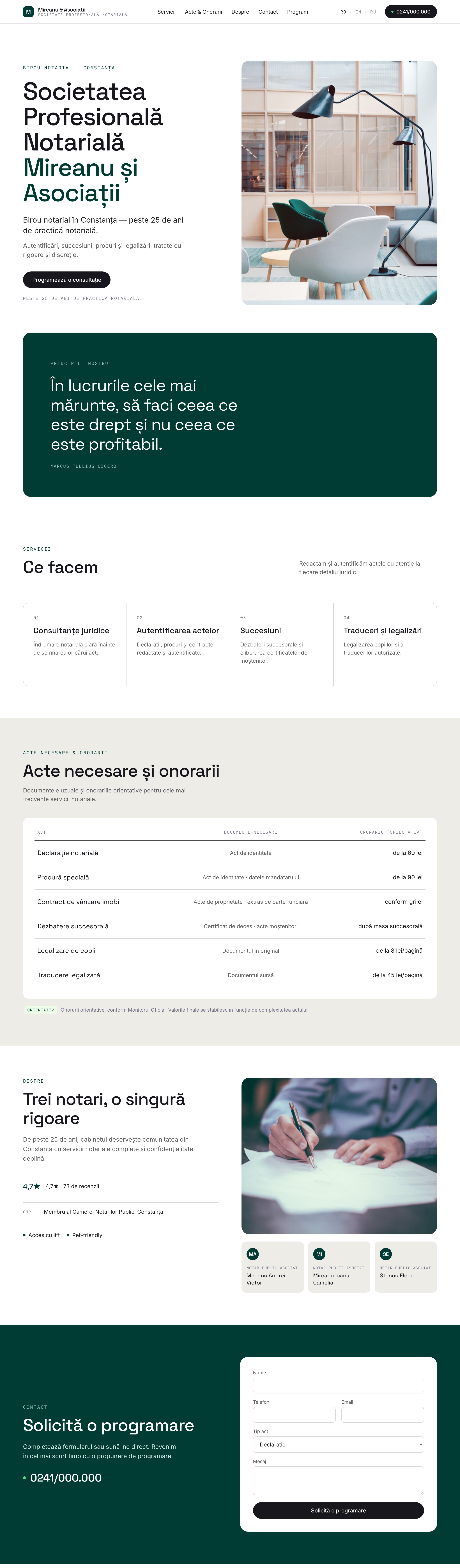
An appointment-request form, not a marketing funnel. Name, phone, type of act, message - a quiet white card with a single dark submit. The most valuable feature on the page, and the one no competitor offers.
Required documents and fees as a dignified table. Rule-separated rows - act on the left, notes in the middle, indicative fee on the right. Published fee schedules are expressly allowed; presenting them plainly is itself a trust signal.
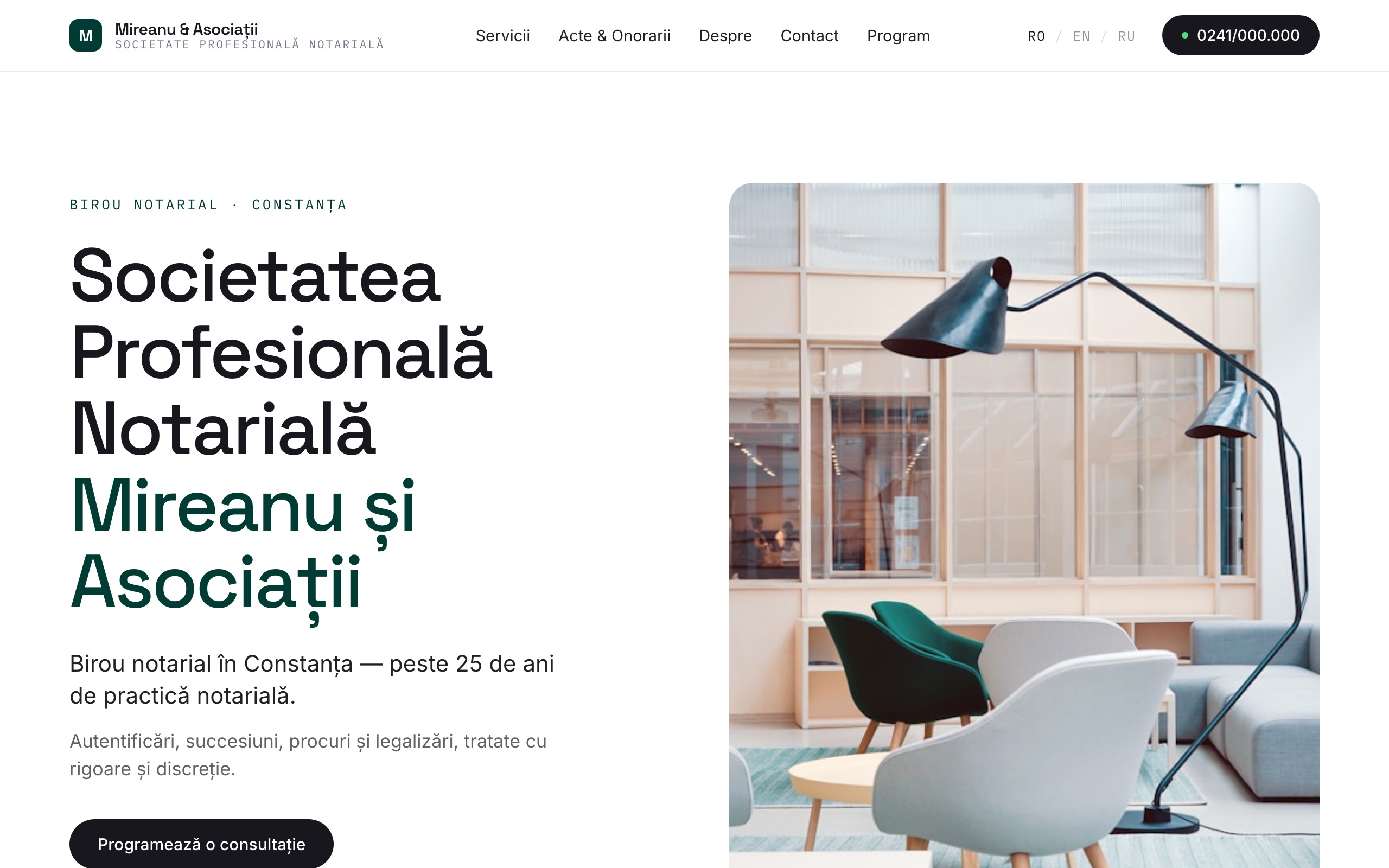
A trilingual site for a trilingual practice. A Română · English · Русский switch rendered in quiet mono labels - finally capturing in writing the clients the office already serves in person.
The essentials always within reach. Hours, address, map, and a persistent phone number in the header - because most notary business still begins with a call.
The design
The local field is free templates and early-2000s static pages; the generic alternative is fintech blue and startup gradients - wrong register in the other direction. We built on a white editorial canvas with generous whitespace doing the trust work, a deep enterprise green as the single brand moment - a full-width statement band carrying the office's motto and its chamber affiliation - and a restrained type pairing with document-like mono labels for act codes and the language switch. No gradients, no shadows, no hype. It reads as what it is: a modern legal institution, not a shop and not a startup.
What it's built to do
As a concept it hasn't shipped, so we won't quote numbers we didn't earn. But every choice targets a specific job:
Carry the offline reputation online - so the Google listing finally shows a site worthy of the rating next to it.
Capture the foreign-buyer clientele in writing - English and Russian pages for the clients the office already serves by voice.
Turn comparison searches into appointments - the only office in the list a prospective client can actually reach without a phone call.
Stay effortlessly compliant - every section maps to what the profession's code permits, which is a differentiator no generic agency brings.
Under the hood
Founder-direct doesn't mean a lightweight build. The concept is engineered the way we build everything: fast on a mid-range phone, structured to be found on Google from day one, and backed by a personalized CMS so the office can keep hours, fees, and required-document lists current without ever touching code - or hand it to us and never think about it again.